
















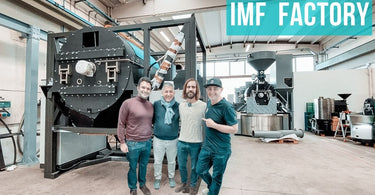
Inside the IMF Factory: How Advanced Coffee Roasting Technology is Revolutionizing Roasting Efficiency
When it comes to commercial coffee roasting, choosing the right machinery can mean the difference between inconsistent batches and peak operational efficiency.
We recently visited the IMF Roasters factory in Occhiobello, Italy, for an exclusive, behind-the-scenes look at how these world-class coffee roasters are designed, engineered, and assembled.
From full factory automation to patented airflow systems, here is what makes IMF coffee roasters a top choice for commercial roasters looking to scale without compromising on coffee quality.
Watch our YouTube video tour of IMF.
1. Versatile Scaling: From Specialty Roasters to Industrial Giants
Walking through the assembly floor in Occhiobello reveals the sheer scale of IMF’s manufacturing capabilities.
-
Entry-Level Specialty Roasters (15kg): Perfect for growing businesses step-by-step. The 15kg model delivers high thermal power, enabling fast, consistent roast cycles (up to 6 to 7 cycles per hour for light roasts).
-
Mid-to-Large Commercial Roasters (30kg to 60kg): Engineered with an ultra-compact footprint. A 60kg setup fits onto roughly three pallets, integrating the afterburner, de-stoner, and control software into a single unit.
-
Industrial Scale (240kg to 480kg+): Heavy-duty machines built to run up to 3 shifts a day, 365 days a year, for high-volume commercial production.
Every unit is designed for simple logistics. Machines up to 60kg fit neatly inside standard shipping containers, drastically cutting down on transit costs, handling fees, and setup time. In fact, most machines are nearly "plug-and-play," allowing roasteries to be operational within hours of delivery.

2. Factory-Wide Engineering & Custom Plant Design
IMF isn't just a roaster builder—they are complete process engineers.
During our tour with process engineer John Pietro, we looked at how IMF designs complete, custom-built coffee processing plants using advanced 3D modelling and Piping & Instrumentation Diagrams (P&ID).
Key Plant Integration Features:
-
Automated Green Coffee Intake: Automatic bag-cutters streamline green coffee receiving.
-
Integrated Cleaning Systems: Multi-stage cleaning using shelf cleaners, continuous weighing systems, and dry de-stoners before beans reach storage silos.
-
Plant Revamping: Custom solutions engineered to replace existing roasters within a customer's current footprint.
Every detail—from hand-welded components to internal drum geometry—is tested on-site before shipping to ensure maximum longevity (often 10 to 15+ years of continuous service).

3. The Core Technology: The Patented Vortex Valve & Single Burner System
What makes IMF roasters stand out in terms of fuel efficiency and roast control? The key lies in their patented Vortex Valve technology.
  +-------------------------------------------------+
  |             Single Gas Burner                   |
  |  (Generates Heat & Cleans Exhaust Emissions)    |
  +------------------------+------------------------+
                           |
                           v
  +-------------------------------------------------+
  |               IMF Vortex Valve                  |
  | (Blends 600°C+ Air with Fresh Ambient Air)      |
  +------------------------+------------------------+
                           |
                           v
  +-------------------------------------------------+
  |               Roasting Drum                     |
  |    (Delivers Precise, Convection Heat)          |
  +-------------------------------------------------+
Key Technical Advantages:
-
Dual-Use Combustion Chamber: The system uses one burner to perform two jobs: generating heat for the roast and burning off exhaust emissions (acting as an integrated afterburner).
-
Reduced Fuel Consumption: Operating with a single burner significantly cuts gas consumption and maintenance compared to traditional setups requiring separate afterburners.
-
Zero Thermal Inertia: Heat adjustments react instantly through the Vortex Valve, giving the roast master absolute precision over every profile point without waiting for heat retention to adjust.

4. Total Convection Control & Uniform Roasting
Traditional drum roasters often rely heavily on conduction, which can lead to scorching or uneven roasts if green beans rest against the hot drum wall for too long.
IMF solves this with reversing internal flighting and high-velocity airflow:
-
Fluidized Movement: Special internal fins keep the mass of coffee constantly turning and suspended, allowing heated air to evenly envelop every single bean.
-
Even Heat Transfer: Eliminates differences between the inner core and outer shell of the roasted bean, resulting in higher extraction yields and a cleaner flavour profile.
-
Batch Capacity Flexibility: Thanks to precise air and drum inverter controls, operators can roast wide capacity ranges—from small test batches (down to ~20-25% capacity) up to full loads—without losing temperature control.

Summary: Engineered for Efficiency and Longevity
Seeing the precision engineering at the IMF factory reinforces why so many specialty and commercial roasters rely on their equipment. By combining integrated afterburners, automated plant designs, and the patented Vortex Valve, IMF offers a powerful balance of top-tier roast quality, lower operational costs, and long-term durability.
Have Questions About Commercial Coffee Roasting?
Are you considering upgrading your roastery or exploring new roasting technology? Leave your questions in the comment section of our YouTube video. Don't forget to like, subscribe, and share this post with anyone looking to scale their coffee business.
👉 If you want to learn more about IMF and their state of the art roasters you will find them online at this address: https://www.imf-srl.com/en/


