














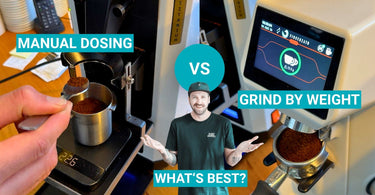
If you run a specialty coffee setup, café, or busy espresso bar, you’ve likely asked yourself: Is it finally time to upgrade to a grind-by-weight (GBW) grinder?
For years, the gold standard for high-consistency espresso bars meant using a time-based grinder (like the classic Anfim SP2) and manually weighing doses into dosing pots using precision scales. But with recent leaps in technology—and much more accessible price points—grind-by-weight options like the Fiorenzato F83 E Pro Sense are making a compelling case to replace traditional workflows.
So, is the investment worth it? Here is an honest breakdown of the workflow differences, speed impacts, training benefits, and benchtop realities of making the switch to GBW.
Continue reading the blog post or watch our YouTube video here instead.
Traditional Workflow vs. Grind-by-Weight: The Real-World Test
To evaluate if GBW is worth the upgrade, let's compare the daily workflow of a traditional timed grinder with dosing pots against a modern grind-by-weight grinder.
1. The Traditional Timed Grinder (e.g., Anfim SP2 + Dosing Pots)
Using a timed grinder with dosing pots and external scales has long been a favorite method for quality-focused baristas.
-
The Workflow: You turn on your scales, activate the timed grind into a dosing pot, and use that grinding window to clean your portafilter. Once ground, you weigh the dose, manually topping up or scooping out coffee to hit your exact target (e.g., 22.5 grams), and then transfer it to your portafilter.
-
The Pros: Dosing pots help break up clumps for an even coffee bed, and grinding while cleaning the portafilter lets you multitask.
-
The Cons: You constantly have to manage the dose. If the timed grind gives you 20 grams instead of 22.5, topping up and re-weighing drains precious seconds on every single order.

2. The Grind-by-Weight Grinder (e.g., Fiorenzato F83 E Pro Sense)
GBW grinders utilize built-in load cells to weigh the coffee in real time as it dispenses directly into your portafilter.
-
The Workflow: Lock the portafilter into the grinder mount. The grinder automatically tares the weight and grinds directly to your precise recipe target—stopping automatically when it hits the exact grammage.
-
The Pros: Zero manual weighing, topping up, or scooping. You get a perfect dose every time regardless of external factors.
-
The Cons: You lose a slight amount of multitasking time since the portafilter is locked into the grinder during the grind, and grinding directly into portafilters requires careful handling to avoid spill waste.

3 Game-Changing Advantages of Grind-by-Weight
1. Eliminating "Top-Up Time"
While dosing pots allow you to multitask during the grind, you lose that saved time the moment a timed grinder dispenses a dose that is 1 or 2 grams off. Over a busy morning rush, the cumulative time spent topping up or scooping out excess grounds far outweighs the few seconds saved during grinding. GBW eliminates dose management entirely.
2. Simplified Barista Training & Burr Wear Compensation
As grinder burrs wear down over time—or as you adjust your grind size coarser or finer throughout the day—a timed grinder will naturally yield different dose weights. This requires baristas to constantly enter the grinder menu to adjust grind times.
With a GBW grinder:
-
The machine adjusts automatically to deliver the set target weight.
-
Grind adjustments and burr wear do not mess with your dose weight.
-
Onboarding new staff and training wholesale cafe partners becomes vastly simpler.
3. Lower Price Points & Superior Accessibility
In the early days of GBW, machines were prohibitively expensive, costing upwards of $5,000–$6,000. Today, grinders like the Fiorenzato F83 E Pro Sense (and 64mm alternatives) deliver commercial-grade grinding and accurate scale technology at a much more approachable price point for cafes of all volumes.
The Hidden Gotcha: Benchtop Stability & Tare Speed
Before buying a GBW grinder, there is one critical technical detail many cafe owners overlook: your benchtop stability.
Because GBW grinders rely on highly sensitive internal scales (load cells), any vibration or flex in your counter can cause the scale to flicker or delay its "tare" time before grinding.
-
High Sensitivity: Grinders like the Mahlkönig E80S GBW or Mazzer Kony SG require an extremely rigid, solid surface. Flexing stainless steel benches can cause scale errors or workflow delays.
-
Lower Sensitivity / Higher Tolerance: Models like the Fiorenzato F83 are designed to be less sensitive to minor bench movement, making them a forgiving choice for varied café setups.
The Verdict: Is It Worth Upgrading?
If you are running a commercial coffee setup and looking to drive consistency while lowering labour and training friction, upgrading to a grind-by-weight grinder is well worth the investment.
While traditional dosing-pot workflows still have a place for some baristas, removing manual dose management from your bar eliminates speed bottlenecks, reduces coffee waste, and keeps your shots tasting consistent all day long.
Ready to Upgrade Your Espresso Setup?
Looking for the right grinder for your espresso bar? Explore our full range of commercial grinders—including the Fiorenzato F83 E Pro Sense—at Artisti Coffee Roasters. We ship equipment and fresh specialty coffee beans all across Australia and worldwide.
Have questions about which grinder fits your volume? Reach out to the Artisti team online today or drop your thoughts in the YouTube comments section!


