












Coffee Grinder Guide: Burrs, Dosing, and Tech Explained
Are you looking to upgrade your home coffee game but feeling overwhelmed by the jargon? Between conical vs. flat burrs, stepped vs. stepless, and single dosing vs. hoppers, there is a lot to take in.
The truth is, your grinder is arguably more important than your espresso machine. If you can’t get a consistent grind, you can’t get a consistent shot. Today, we’re stripping back the tech and looking at the main differences in grinder technology to help you find the perfect fit for your morning routine.
1. Conical vs. Flat Burrs: Does Shape Matter?
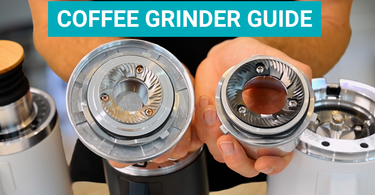
The "burrs" are the heart of your grinder—the blades that turn whole beans into coffee grounds.
-
Conical Burrs: These are cone-shaped. Gravity does most of the work, feeding the beans down through the center. They generally produce a "bolder," punchier flavor profile with less acidity. They are common in entry-level grinders (like the Breville Smart Grinder Pro) because they are efficient and easier to manufacture.

-
Flat Burrs: Think of these like two donut-shaped discs sitting on top of each other. Centrifugal force pushes the beans outward. Flat burrs are prized for clarity and sweetness. If you love fruity, light-roast single origins, a flat burr (like the 64mm Dark T burrs in the Fiorenzato All Ground) will help you find those refined flavors.

2. Dosing: Time-Based vs. Weight-Based
How do you get the right amount of coffee into your handle? There are two main ways:
-
Time-Based: You set the grinder to run for, say, 7 seconds. The Trap: If you change your grind setting to be finer, less coffee will come out in those 7 seconds. You have to constantly adjust the timer as you dial in.
-
Weight-Based (GbW): This is the game-changer. Grinders like the Fiorenzato All Ground Sense have built-in scales. You set it to 20g, and it grinds exactly 20g regardless of how fine or coarse the setting is. It removes the guesswork and saves a ton of time.

3. Hopper vs. Single Dose
This comes down to your lifestyle and "workflow."
-
Hopper Grinders: Great for convenience. Fill the top with a week’s worth of beans, walk up, and hit a button. It’s perfect if you stick to one blend for your morning milk coffees.
-
Single Dose Grinders: Grinders like the DF54 have no hopper. You weigh your beans (e.g., 20g) into a small pot, dump them in, and grind until empty. This is ideal if you like to switch between decaf, single origins, and blends throughout the day with zero wastage.

4. Stepped vs. Stepless Adjustment
How much control do you need?
-
Stepped: The adjustment collar "clicks" into set positions. It’s easy to repeat settings, but sometimes the perfect grind size sits between two clicks.
-
Stepless: You have infinite adjustment. You can move the collar a fraction of a millimeter to nail that 30-second extraction perfectly.
5. The "Old Coffee" Problem (Retention)
If you use a hopper grinder, remember that there is always a small amount of coffee sitting in the "chute" between the burrs and your portafilter. If you haven't made a coffee since yesterday, that first half-shot is stale! Pro Tip: Always do a small "purge" (about 4g) in the morning to clear out the old grinds before you pull your first real shot.
Which Grinder is Right for You?
-
The Busy Professional: Go for a Hopper-fed, Weight-based grinder. Fast, accurate, and easy.
-
The Coffee Explorer: Go for a Single Dose, Stepless, Flat Burr grinder. It gives you the ultimate control over every different bean you try.
Ready to find your perfect match? We’ve done deep-dive video reviews on the Breville Smart Grinder Pro, the DF54, and the Fiorenzato All Ground Sense. Check them out on our YouTube channel to see them in action!


