















Geeking Out on Flow Control: A Guide to Brewing on the Lelit Bianca V3
When home baristas begin researching high-end dual boiler espresso machines, the Lelit Bianca V3 frequently tops the list. While standard prosumer setups lock you into a fixed pressure profile, the Bianca is built specifically for experimentation. Featuring manually adjustable flow profiling, independent boiler temperature management, and customizable electronic pump pre-infusion, this machine completely shifts how you approach extraction.
However, moving past standard brewing parameters requires shifting your workflow. Let's break down what it is actually like to brew on the Lelit Bianca, how flow profiling impacts your puck mechanics, and how to get the most out of its advanced features.
Watch our YouTube Video here instead.

The Workflow Foundation: Pairing with a Single-Dose Grinder
If your daily routine consists of grinding directly into a standard hopper, tamping, and hitting a pre-timed button to make a classic morning latte, the Bianca will perform flawlessly at a standard, flat profile. However, to truly utilize its flow profiling and temperature controls, you need to pair the machine with a high-quality single-dose grinder (such as the DF54).
┌────────────────────────────────────────────────────────┐
│               THE RETAIN VS. WASTE BALANCE             │
├───────────────────────────┬────────────────────────────┤
│   Traditional Hopper      │    Single-Dose Grinder     │
├───────────────────────────┼────────────────────────────┤
│ • Heavy grind retention   │ • Near-zero grind retention│
│ • Slow parameter tuning   │ • Instant grind changes    │
│ • High bean waste per dial│ • Zero stale bean exchange │
└───────────────────────────┴────────────────────────────┘

When you adjust the physical flow rate or dropped pressure at the group head, your grind size must adjust to match that specific flow environment. If you pull a shot at a restricted 3 bars of pressure using a grind setting dialled in for 9 bars, the water will barely move through the puck. A single-dose grinder allows you to make rapid, micro-adjustments to your particle size between consecutive shots without wasting a massive amount of stale coffee trapped inside an internal grinding chute.
Understanding the Fluid Dynamics of Flow Profiling
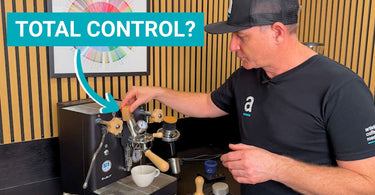
The centrepiece of the Lelit Bianca V3 is the wooden paddle mounted directly on top of the E61 group head. This manually controls an internal needle valve that regulates the volume of water entering the chamber.
-
Full Open (9-10 Bars): The needle valve allows the machine's robust internal rotary pump to deliver maximum water flow straight to the puck.
-
Closed/Restricted: Constricts the aperture, dropping the line pressure right down to zero.

The Reality of Back Pressure
A common point of confusion for developing home baristas is assuming that setting the flow control paddle to a "3-bar position" means the coffee puck experiences exactly 3 bars of pressure throughout the entire extraction.
In reality, the pressure reading on the group head gauge is heavily determined by back pressure built up by the resistance of the coffee puck itself. If your grind profile is highly restrictive and fine, water will saturate the puck, back up inside the E61 group head chamber, and force the pressure gauge all the way to 9 or 10 bars, regardless of a low paddle position.
To execute a true "reducing profile"—starting high at 9 bars and smoothly finishing at 6 bars—you must continuously back off the wooden paddle as the puck naturally erodes during the extraction cycle.
Advanced Electronic Profiling: Pre-Infusion & Low-Flow Modes
Beyond the manual wooden paddle, the Lelit Bianca V3’s digital control pad lets you program distinct, automated pump-power stages:
-
Programmable Pre-Infusion: You can configure the internal rotary pump to activate for 2 seconds, pause completely for 2 seconds to let the puck expand and saturate cleanly, and then resume full operation. This swelling behaviour fills micro-voids inside the coffee bed, reducing the risk of side-channelling.
-
Low-Flow State: You can dictate a specific duration (e.g., 3 seconds) where the internal pump runs at a reduced power draw. This limits the initial impact speed of the water before ramping the system up to maximum bar pressure.
Throwing Out the Standard Recipe Book
When you begin adjusting the water flow, standard barista rules—like aiming for a strict 1:2 extraction ratio ( dry dose to liquid yield) in exactly 30 seconds—no longer apply.
┌────────────────────────────────────────────────────────┐
│                FLAVOR PROFILE ALTERATIONS              │
├───────────────────────────┬────────────────────────────┤
│  Standard 9-Bar Extraction│   Declining Flow Profile   │
├───────────────────────────┼────────────────────────────┤
│ • Heavy caramelization    │ • Enhanced fruit clarity   │
│ • Deep, bitter roast notes│ • Softer, balanced texture │
│ • High, thick viscosity   │ • Lighter overall body     │
└────────────────└──────────┴────────────────────────────┘
During a long, low-pressure profiling run (which can easily clock 60 to 66 seconds total duration), the resulting shot behaves entirely differently. Because the extraction avoids the harsh impact of sustained 9-bar pressure, it pulls out a highly viscous, syrupy, molasses-like yield that is remarkably balanced, light in body, and completely free of bitter, over-extracted notes.
Utilizing Dual Boiler Temperature Controls
The secondary boiler inside the Bianca allows you to precisely adapt your extraction temperatures to match specific roast styles:
-
Light/Filter Roasts (): Lightly roasted beans are dense and chemically resilient. Bumping up the temperature provides the thermal energy required to extract complex fruit acids and intrinsic sweetness.
-
Dark/Traditional Roasts (): Darker roasts are highly porous and soluble. Dropping the temperature helps prevent over-extracting bitter, burnt compounds, resulting in a cleaner, smoother finish.
Lelit Bianca V3 vs. La Marzocco GS3 MP
When comparing high-end pressure-profiling dual boilers, it is important to note how the Bianca manages excess pressure compared to a machine like the La Marzocco GS3 Mechanical Paddle (MP).
On the Lelit Bianca, closing the manual needle valve traps the existing back pressure inside the E61 group head chamber; the pressure has nowhere to go unless you push the main group lever down to exhaust the water into the drip tray. On the La Marzocco GS3 MP, the manual paddle mechanism features a dedicated internal exhaust route. As you back off the paddle, any excess pressure in the head is instantly diverted out into the drip tray, giving you complete, real-time control to drop from 9 bars down to 3 bars mid-shot.

The Verdict: Is Flow Profiling Essential?
Manual flow profiling isn't necessarily something you will use for every single cup on a frantic Monday morning. However, having it built into your setup offers a fantastic playground for geeking out with delicate single-origins on the weekend.
If you are stepping up to a Lelit Bianca V3, the best approach is to lock the flow paddle completely open at first. Master your grind consistency, nail your distribution, and perfect your standard 9-bar recipes. Once your baseline extractions are flawless, start experimenting with the flow paddle to unlock entirely new flavour profiles from your favourite beans.
Explore the Lelit Bianca V3 and Single-Dose Grinder Pairings at Artisti.com.au
Are you ready to dive into pressure profiling, or do you prefer the consistency of a classic, flat 9-bar extraction? Let's start a conversation in the YouTube comments section!


